
Over the last year, I’ve noticed something interesting.
Whether I’m speaking with executives, board members, cybersecurity professionals, or risk teams, the conversation eventually comes back to the same question:
How do we govern AI without slowing down innovation?
Everyone wants to take advantage of AI. Organizations see the opportunities. They see the productivity gains, the business value, and the competitive advantage.
What many are still figuring out is how to manage the risks that come with it.
That’s one reason I find it useful to look at companies like OpenAI, Anthropic, and Google. Not because they have all the answers, and certainly not because every organization should copy what they’re doing. But because they’re dealing with many of the same governance challenges that businesses everywhere are beginning to face.
The difference is that they’re dealing with those challenges at a much larger scale and under far greater scrutiny.
Governance Is About More Than Compliance
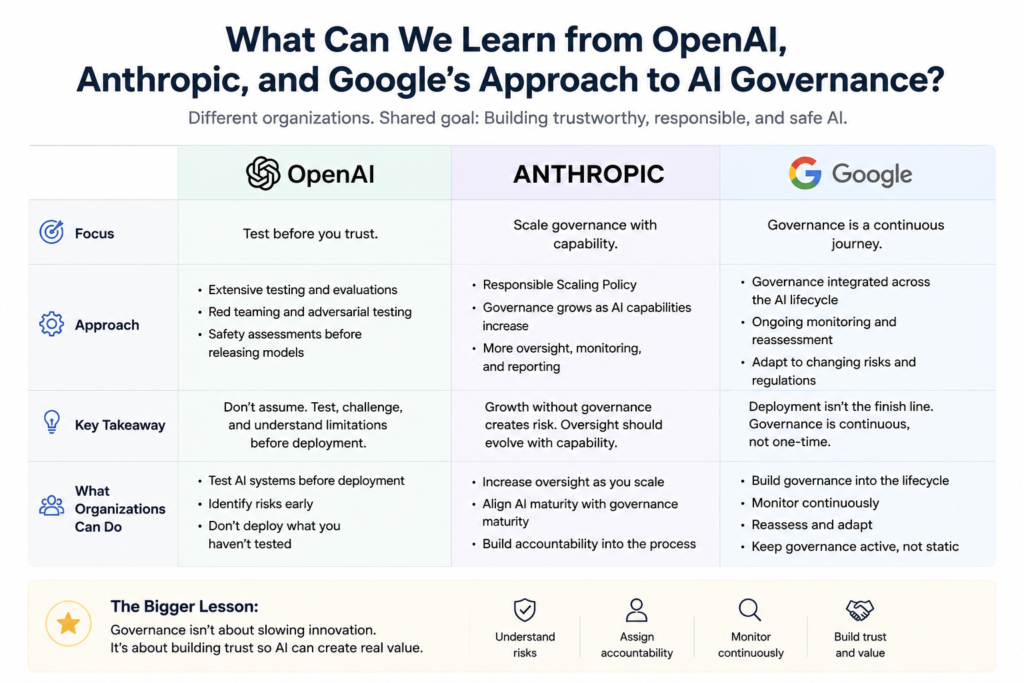
One thing that stands out when looking at these companies is that governance isn’t treated as a compliance exercise. It’s treated as a business necessity.
That’s an important distinction. Too often, governance is viewed as something that slows projects down, creates paperwork, or exists simply to satisfy regulators. In reality, good governance helps organizations make better decisions. It creates accountability. It clarifies responsibilities. It helps leadership understand where risks exist and what needs attention. Most importantly, it helps build trust.
And if there’s one thing I’ve learned from working in cybersecurity and risk management, it’s that trust takes years to build and only moments to lose.
OpenAI: Test Before You Trust
One thing I respect about OpenAI’s approach is its focus on testing.
Before releasing new models, they invest heavily in evaluations, red teaming, security reviews, and safety assessments.
That shouldn’t be surprising. No organization would deploy a critical business system without testing it first. AI should be no different.
Yet I’ve seen organizations rush to implement AI tools before fully understanding how they work, what risks they introduce, or what could happen when outputs are wrong.That’s where problems start. The lesson here isn’t that every company needs a team of AI researchers.The lesson is much simpler. Don’t assume because an AI tool is impressive that it’s ready for production use. Test it. Challenge it. Understand its limitations before your users discover them for you.
Anthropic: As Capability Grows, So Should Oversight
What I find particularly interesting about Anthropic is its emphasis on responsible scaling.
The idea is straightforward. As AI systems become more capable, governance should become stronger. Unfortunately, I’ve seen the opposite happen in some organizations. AI adoption expands rapidly, but governance remains largely unchanged. The technology evolves faster than the controls around it. That’s a risky position to be in. As organizations increase their use of AI, they should also increase oversight, monitoring, reporting, and executive engagement. Growth without governance eventually creates problems. The question isn’t whether those problems will appear. It’s when.
Google: Governance Doesn’t End at Deployment
Google’s approach highlights another lesson that organizations sometimes overlook. Governance is not a one-time approval process. It’s ongoing.
Many organizations perform reviews before deployment and then move on to the next project. But AI systems don’t remain static. Data changes. Threats evolve. Regulations develop. Business objectives shift. An AI system that appears low risk today may look very different six months from now.
That’s why governance should be viewed as a continuous process rather than a milestone. Deployment isn’t the finish line. In many ways, it’s where governance becomes even more important.
The Resource Question Nobody Likes to Discuss
Here’s the reality. Effective AI governance requires investment. Policies alone won’t solve the problem. Frameworks alone won’t solve the problem. Organizations need people, expertise, processes, and resources. The companies leading in AI governance invest heavily in security teams, legal experts, risk professionals, engineers, auditors, and governance functions. Most organizations won’t have those resources available. That’s fine. The objective isn’t to match OpenAI, Anthropic, or Google dollar for dollar. The objective is to recognize that governance cannot be treated as a side project. If AI is important enough to invest in, governance should be too.
What Other Organizations Should Take Away
The biggest lesson isn’t about adopting a specific framework or copying a particular policy. It’s about mindset. Know where AI is being used. Understand the risks. Assign accountability. Test systems before deployment. Monitor them after deployment. Create a process for escalating concerns. And don’t wait for a crisis to discover governance gaps. Organizations often ask when they should start building AI governance. My answer is simple: The best time was before deployment. The second-best time is now.
Governments Create Rules. Companies Build Trust.
As governments around the world continue developing AI regulations, there is often a debate about who bears responsibility for ensuring AI is used safely and responsibly. The answer is both. Governments have an important role in establishing legal boundaries, protecting citizens, and creating accountability. But regulation alone won’t create responsible AI. Organizations must do their part as well. They are the ones making decisions about how AI is developed, deployed, monitored, and governed every day. The future of AI won’t be shaped by lawmakers alone. It won’t be shaped by technology companies alone either.
It will depend on how effectively governments, businesses, researchers, and society work together to address challenges that none of us can solve independently.
When I look at OpenAI, Anthropic, and Google, I don’t see organizations that have solved every AI governance challenge. What I see are organizations that recognize governance is not optional. They understand that trust has to be built into the process, not added later. That’s a lesson every organization can learn from, regardless of size or industry.