
Gartner: AI Vulnerability Discovery Is Top Risk
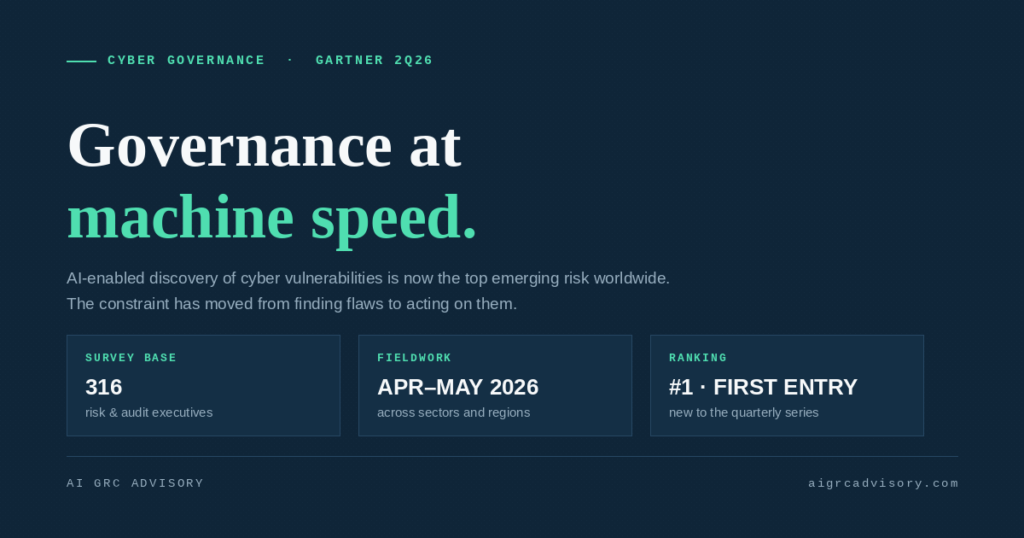
On 25 August 2026, Gartner published the results of its Quarterly Emerging Risks Report for the second quarter of the year. For the first time in the history of that series, AI-enabled discovery of cyber vulnerabilities took the top spot. The finding comes from a survey of 316 senior executives, risk managers, and auditors conducted across sectors and regions in April and May 2026.
I have spent enough time in both operational security and public sector governance to be skeptical of quarterly risk rankings. They tend to reflect what people read last month more than what actually breaks organizations. This one is different, and it is worth reading carefully, because the underlying claim is not about a new threat actor or a new class of malware. It is a claim about tempo. And tempo is a governance problem before it is a technical one.
On 25 August 2026, Gartner published the results of its Quarterly Emerging Risks Report for the second quarter of the year. For the first time in the history of that series, AI-enabled discovery of cyber vulnerabilities took the top spot. The finding comes from a survey of 316 senior executives, risk managers, and auditors conducted across sectors and regions in April and May 2026.
I have spent enough time in both operational security and public sector governance to be skeptical of quarterly risk rankings. They tend to reflect what people read last month more than what actually breaks organizations. This one is different, and it is worth reading carefully, because the underlying claim is not about a new threat actor or a new class of malware. It is a claim about tempo. And tempo is a governance problem before it is a technical one.
The Finding, Plainly Stated
Gartner’s argument is that AI is making vulnerability discovery cheaper, faster, and far more accessible—and that conventional risk management is struggling to keep up. The senior analyst behind the report, Kevin Mercado, warns that without matching improvements in governance, security operations, and remediation capability, AI-assisted discovery will simply outrun organizational defenses, raising the odds of serious incidents and operational disruption.
Gartner also notes an uncomfortable gap: many organizations report confidence in their readiness for AI-driven cyber threats, while vulnerabilities are being found and weaponized faster than their processes were designed to handle. Confidence and capability are drifting apart. In my experience, that gap is almost always the product of governance that measures activity rather than exposure.
The report offers four corrective moves:
- Recalibrate risk impact assessments for amplified exposure.
- Update risk appetite to reflect the continuous nature of vulnerability discovery.
- Tighten third-party controls so suppliers do not import risk.
- Accelerate response through faster patching and automated remediation
Alongside the headline risk, the report flags agentic AI operating outside organizational oversight, threats to information integrity from unreliable data and synthetic content, workforce gaps in AI skills, and geopolitical pressure on energy supply chains.
Why This Is a Governance Story
It is tempting to read this as a vulnerability management problem and hand it to the patching team. That would be a mistake. If the interval between disclosure and exploitation compresses, then almost every decision right in the governance model becomes time-sensitive. Committees that meet monthly, exception processes with no expiry, risk appetite statements written for a world of quarterly patch cycles: all of these were calibrated against an adversary tempo that no longer holds.
Here is how I would map the finding across the governance domains that actually own the response:
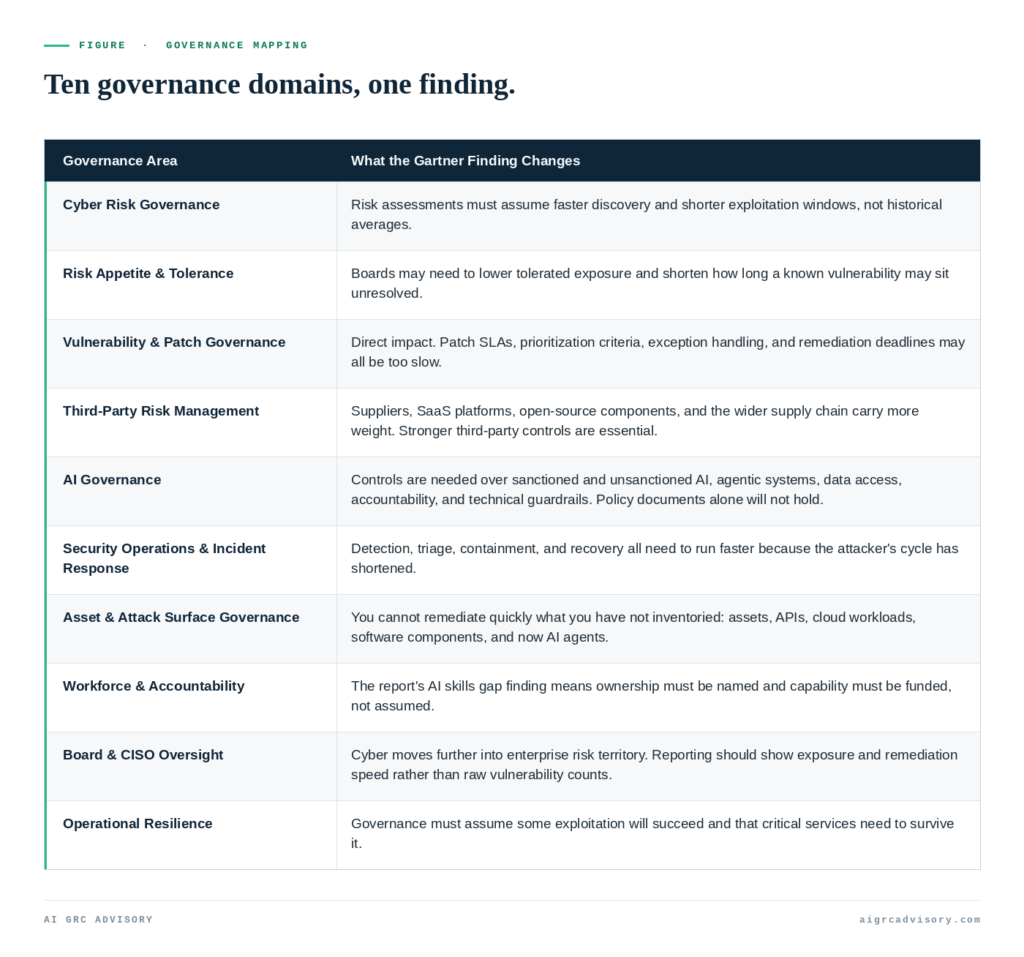
Domains affected: Cyber Risk Governance · Risk Appetite & Tolerance · Vulnerability & Patch Governance · Third-Party Risk Management · AI Governance · Security Operations & Incident Response · Asset & Attack Surface Governance · Workforce & Accountability · Board & CISO Oversight · Operational Resilience
If I had to compress the whole report into one sentence for a board, it would be this: governance now has to operate at machine speed.
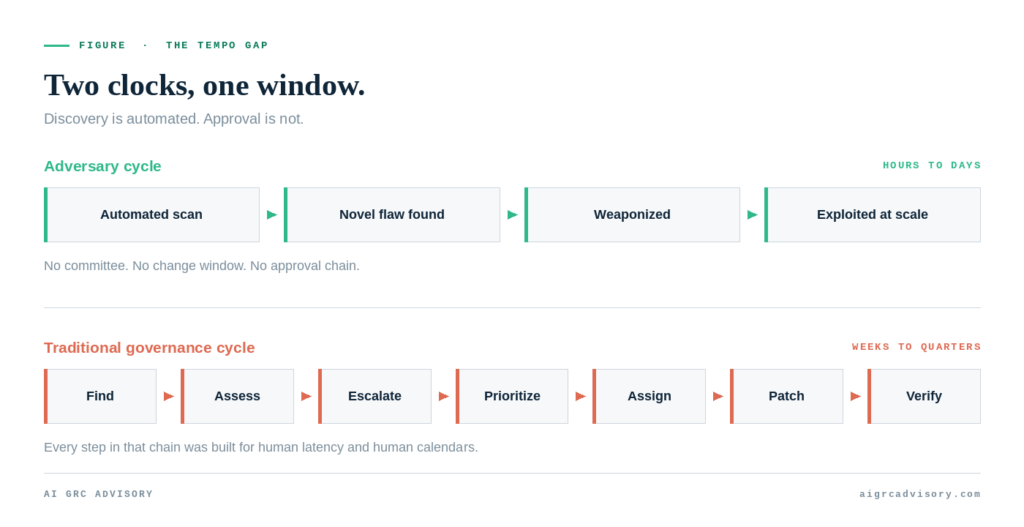
Traditional governance cycle: find → assess → escalate → prioritize → assign → patch → verify.
Every step in that chain was designed for human latency and human calendars. When discovery is automated and exploitation follows within days or hours, a governance model built on scheduled meetings becomes a source of risk rather than a control on it.
That does not mean abolishing oversight. It means moving human judgment upstream:
- Decide in advance what gets patched automatically and under what conditions.
- Pre-authorize emergency change paths for defined asset classes.
- Set expiry dates on every exception.
- Delegate authority to act, and hold the delegation accountable through reporting—rather than requiring a committee to approve each individual action while the window closes.
What Leadership Should Be Measuring
Vulnerability counts are a vanity metric. They rise when scanning improves and fall when it degrades. If the risk has become a question of speed, then metrics must measure speed and exposure:
- Time Metrics: Time to detect, time to triage, and time to remediate—tracked as distributions rather than averages.
- SLA Drift: Percentage of critical vulnerabilities outside SLA, and how long they have been outside it.
- Internet-Facing Exposure: What is reachable, from where, and how quickly it can be taken out of reach.
- Third-Party Concentration: Third-party exposure, including the concentration of risk in a small number of suppliers.
- Exception Ageing: Exception aging, with a hard look at anything that has been renewed more than once.
- Automation Ratio: Percentage of remediation that can be executed safely without human approval, and whether that percentage is growing.
- Inventory Coverage: Coverage of the asset inventory, including AI agents and the credentials they hold.
Any one of these will produce a far more useful board conversation than a slide showing ten thousand open findings.
A Note for the Public Sector
Government bodies face a harder version of this problem. Procurement cycles are long, legacy estates are deep, change control is often bound by statute rather than policy, and the pressure to demonstrate compliance can crowd out the work of actually reducing exposure. None of that changes the adversary’s tempo.
Three practical priorities for public sector leaders:
- Segment Legacy Assets: Treat legacy systems that cannot be patched at speed as candidates for compensating controls and segmentation now, not as a future modernization line item.
- Contractual SLAs: Push remediation timelines and evidence requirements directly into supplier contracts—in most government estates, the majority of the exploitable surface sits with vendors.
- Enforceable AI Controls: Make AI governance enforceable at the technical layer: identity, logging, data access boundaries, and agent permissions. A policy that no system enforces is a document, not a control
Gartner has effectively told the market that the constraint has moved. The scarce resource is no longer the ability to find vulnerabilities. It is the ability to decide and act before someone else acts on the same information. Governance frameworks built to demonstrate diligence over a reporting period now need to demonstrate responsiveness over hours and days.
The organizations that come through the next two years well will not be the ones with the thickest policy libraries. They will be the ones that decided in advance what they were willing to automate, who was allowed to act without asking, and what they would keep running when something inevitably gets through.
Source: Gartner, “Gartner Survey Finds AI Discovery of Cyber Vulnerabilities is Top Emerging Risk in Second Quarter of 2026,” press release, 25 August 2026.